|
READING
Style
In the process of composing an image an artist is exhibiting a style.
Composition and style go hand-in-hand.
The way an artist manipulates each of the visual elements and how he or she treats objects is called style.
The word style also describes the way the whole composition has been conceived and composed.
Many artworks share distinctive stylistic features and so can be grouped together.
Style is the essential connective tissue that serves to link the artworks of a single artist, or the works of several artists in a movement or school, or of many artists in a city, region, or country.
Through the analysis and identification of style, art historians make stylistic connections between one artwork and another and thereby bring a semblance of order to an otherwise overwhelming multitude of endlessly diverse works of art stretching back into the distant past.
Art historians use the connectedness of style to construct an explanatory “history” of art.
The history of art is conventionally divided into a series of periods: Gothic, Renaissance, Baroque, and so forth.
The concept of a “period” (a term designating a portion of historical time with distinguishing characteristics) is largely a product of the nineteenth century.
It is a convenient way of organizing the events of the past.
Each period serves as a useful pigeonhole the social, political, religious, and cultural characteristics of which provide the basic ideas underpinning the analysis of all the art produced at that time.
For example, the Renaissance (the term was first used to designate the period in a specific and comprehensive way by the French historian Jules Michelet in 1855) is generally characterized by the re-birth of Classical ideas and forms, the rise of humanism, and an interest in naturalism.
The Renaissance style of art is believed to embody these characteristics.
The emergence in the nineteenth century of a special interest in style in art is largely due to the German philosophers Immanuel Kant and Georg Hegel who had conceived the view that Art embodied fundamental characteristics of the human mind.
These characteristics were revealed not so much in the subjects shown but in the way they were represented; in other words, in the style of the work.
In the late nineteenth and early twentieth century, the art historians Heinrich Wölfflin and Alois Riegl focused their attention on style, which they analyzed in terms of the basic formal elements of line, shape, color, etc.
They developed a structural description of style and identified the different stylistic types that occurred in each phase of the history of art. Wölfflin is well known for developing a set of stylistic distinctions between Renaissance art and Baroque art.
The impulse behind this work, however, was not only to categorize styles of art but also to illuminate the historical period in which each style appears.
Art was seen as one of the keys to understanding historical periods.
Hegel had claimed that art bears the traces of stages in the development of the human spirit.
He asserted that each age or period in history is the product of a guiding spirit.
It was therefore part of the art historian’s task to uncover, through a careful analysis of style, the underlying spirit of the age.
This spirit was understood to embody not only fundamental characteristics of the human mind, but also showed these characteristics at a particular stage of development.
Hegel believed that art, and the human spirit, had evolved in three stages beginning with the Symbolic, from which emerged the Classical, and culminated in the Romantic.
The idea that art had developed along evolutionary lines over time became a basic working assumption among art historians.
It therefore became important to associate a particular style with a particular period.
The style of the Renaissance, for example, is peculiar to that period, representing, it was claimed, a stage of human spiritual development at that time in history.
This conception of style and periods, however, has been debilitating in the study of art history.
Period style became a generalized stereotype.
Whereas the analysis of style was meant to elucidate the characteristics of a period, the reverse is commonly the case where the concept of the period determines the style of its art.
Periods in effect became straitjackets for style.
Moreover, as there can be only one guiding spirit of the age, there can be only one prevailing style in each period.
This has produced a somewhat Procrustean approach to the analysis of style in any given period. Procrustes was a brigand in ancient Greece whose practice was to tie his guests to an iron bed. If they were too short for the bed, he stretched them. If they were too long, he lopped off their legs to make them fit.
For art historians, it has been a continuous and unsatisfactory struggle to make all the art of a period fit its perceived style.
The necessary stretching and lopping of art has distorted our understanding of art, its styles, and historical periods.
Art, however, can be studied within broader stylistic categories.
Studying Style
In his painting Starry Night, Vincent van Gogh manipulated the basic visual elements of the scene — color, lines, shapes, texture, and space — in a way that creates particular visual impressions and associations.
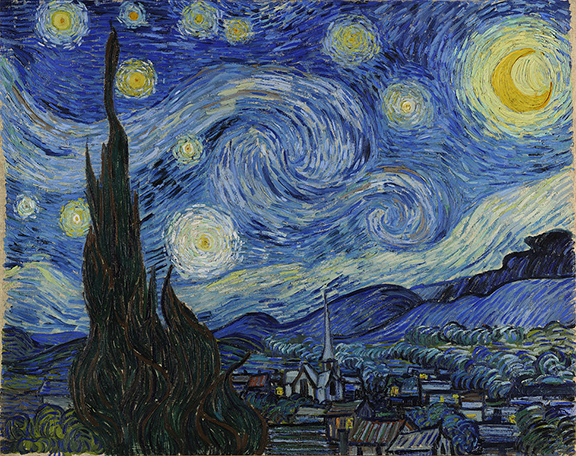
Vincent van Gogh, Starry Night, 1889 (Museum of Modern Art, New York)
The painting is believed to show the view from the window of Van Gogh’s cell in a mental asylum.
Most of the canvas is occupied by the night sky in which the Milky Way appears to swirl amid pulsating stars and an orange crescent moon that glows yellow.
Just above the horizon an undulating band of light in the sky seems to rush along above rolling blue hills that are partly hidden by a dark cypress tree in the foreground.
The tree appears to writhe upward into the sky like a flame.
Van Gogh chose to paint this picture in a style that uses bright colors and linear brush strokes.
Some of the lines are curved, others are wavy, but most of them are short and straight.
This technique of painting is Van Gogh’s way of making a picture, his style.
The resulting visual effect is a nervous, choppy rhythm of lines and shapes within the larger sense of flowing movement.
The painting is dominated by shades of blue mixed with shades of green in both the landscape and the sky.
These cool colors are offset with a few spots of warm orange in the stars and moon and the occasional lighted window, with some brown in the cypress tree and a few lines of dark red in the rooftops.
Various features — houses, the church, the cypress tree, the hills — are outlined in black.
The overall impression is of a dark, sinuous world in which the land and the sky writhe and pulsate with a life of their own.
The only stable and unmoving point is the church with its tall pointed steeple.
By painting the picture in this way, Van Gogh sought to capture not only what he saw, but also how he felt about it.
He deliberately chose a style that best expressed his own personal response to the scene.
The style is so personal to Van Gogh that we feel we can detect in it his private feelings, thoughts, and even his mental state.
It is important to remember, however, that any sense we have of Van Gogh’s feelings and thoughts is due to our response to the painting.
In other words, it is the style Van Gogh used that produces in us, as viewers, certain types of feelings and thoughts.
We then assume that the feelings and thoughts we detect in the image are the same thoughts and feelings Van Gogh had when he was painting the picture and wished to convey to us.
Surviving letters written to his brother, Theo, permit us to confirm that Van Gogh did indeed have feelings and thoughts about the things he was painting that are similar to those we detect in his work.
Ultimately, though, we can never really know what Van Gogh was in fact feeling or thinking at the time he painted Starry Night.
What we do know is that the style used by Van Gogh produces in us certain types of feelings and thoughts.
And it seems likely that Van Gogh did in fact wish to record these very same thoughts and feelings.
The point is, he chose a style — a way of composing lines, shapes, colors, space, and texture — that he believed would be most effective in producing the impressions and associations he wished to record.
Starry Night exhibits Van Gogh’s personal or individual style.
Art historians also examine style in terms of period (period style) and place (city, region and/or country) in which the artist was working (regional style and national style).
Van Gogh’s style is not only his own personal style, it is also, in a more general sense, a product of the place and period in history in which he lived.
In late nineteenth-century France, Van Gogh was one of several artists who were exploring more personal approaches to art and the use of color.
His style is therefore also one that expresses the ideas and attitudes of the Post-Impressionists, as well as aspects of the general sensibility and taste in French culture at the end of the nineteenth century.
Van Gogh’s art, however, is also characteristic of a broader category of style.
Over the millennia, humans have created innumerable images. Despite their diversity, the majority of these images can be grouped according to three basic stylistic categories:
- Abstractionism
- Realism
- Idealism
These categories are identified according to different modes of representation that fulfil broad but deeply rooted expressive needs.
Each of these styles can be thought of as materializing a particular cast of mind into visible images. They both record and express different ways of experiencing the world.
Making images is a natural form of expression for humans.
A young child given a crayon will use it to make lines.
With a little encouragement, a child can be persuaded to make the lines represent something: a house, a person, a cat.
At first, the lines will be so abstracted that no one else but the child can say what they actually represent.
When asked, the child may appear genuinely puzzled by the question because the image is clear enough to them.
When another person fails to recognize the image, the child realizes two things.
First, what makes sense to them may not make sense to someone else.
Second, that if he or she wishes their drawing to be understood, the lines must be made more recognizable.
The motivating impulse is the desire to communicate.
To make images comprehensible to other people requires giving them recognizable forms and features according to prevailing visual conventions.
The child, therefore, embarks on a path of learning how to draw.
This invariably means making the image more representational.
But there are degrees of representation and various choices are open to the artist.
For an artist, making a picture is a matter of deciding what sort of information he or she wants to communicate.
These decisions will determine the style of the image.
An artist may wish to produce an image in which figures, objects and other features appear as they do in the real world.
When an image exhibits this sort of visually accurate correspondence with perceived reality it is called Realistic.
On the other hand, an artist may wish to emphasize only certain characteristics or features, or have the image convey only particular feelings or emotions, or, alternatively, to create more generalized or unspecific effects or associations.
This is best achieved through Abstractionism.
A third choice is to deliberately make an image in which visible reality is regularized, or better organized, or improved, or purified, its qualities artificially enhanced, and its imperfections and deficiencies corrected or suppressed, so that it appears more beautiful or more perfect than it does in reality.
When this is undertaken according to predetermined principles or rules, or according to preconceived notions of beauty, the result is an Idealized image.
Realism, Abstractionism, and Idealism are the three primary styles.
It is helpful to think of the three primary styles as analogous to the three primary colors from which all other colors may be derived.
Unlike the primary colors, however, there are no obvious examples of pure primary styles.
There are no stylistic equivalents of red, blue, or yellow. Moreover, some degree of Abstractionism is always present in both Realism and Idealism.
The lines separating Abstractionism, Realism, and Idealism are not always clear.
However, like the three primary colors, which, when mixed, produce every other color, the three primary styles underlie every other style.
The distinctions between them are rooted in the artist’s aim or intent.
-
ABSTRACTIONISM
The most fundamental and universal approach to making an image is through abstraction.
The term abstract is usually employed by art historians today to describe a type of non-representational art done in the twentieth century.
The term, however, has a broader meaning that needs to be recovered from the narrow context in which it is currently used.
To “abstract” is to extract the essence of an object or idea.
That essence may lie in how an image looks (its actual physical appearance), or in how it feels (its emotional or spiritual aspects), or in some other quality, such as beauty or strength.
An artist may choose to focus on or stress one or another of these essential elements or characteristics in an image.
The ability to abstract is a fundamental, natural human trait. It is the ability to recognize or grasp the whole in a part or in a single feature, and to represent things or ideas through approximation or symbol.
The making of visual images begins with a process of simplification in which the perceived object or conceived entity is reduced to a configuration of lines and shapes.
In many cases, the intent of the artist is to “capture” the physical or spiritual essence of the object or idea in order to convey, at the very least, some essential aspect of its identity or meaning.
The resulting art object is seen or believed to possess the essential or key identifying qualities of the object or idea.
The French painter Henri Matisse explained in his “Notes of a Painter” in 1908 that in his art he sought the “essential lines”.
An abstractionist image represents (literally “re-presents”, that is, presents in a different form) the object or idea in an abbreviated or symbolic way.
Abstractionist art is characterized primarily by the desire or intent of the artist to focus on or stress only certain characteristics or features in an image.
These may be physical, emotional, or spiritual.
In Abstractionist art there is a general lack of interest in producing a fully visually accurate and complete facsimile of visible reality.
Its focus is the essence (the essential qualities or features) of whatever is being represented.
Art is always a re-presentation.
It reproduces only approximations or “abstractions” of visible reality or of an artist’s ideas or mental state.
The artist can never reproduce exactly what is seen or felt. In this respect, all art is basically abstractionist.
Abstractionism is therefore a fundamental primary style and the source from which emerge the two other primary styles: the Idealizing and the Realistic.
- REALISM
Realist art is characterized by the desire or intent of the artist to make an image appear as it would in the real world.
The image may accurately represent what is seen in the real world, or it may be an imagined (or partly imagined) scene that is nonetheless presented as if it were taking place in true reality.
The goal of the artist is verisimilitude (having the appearance of reality, or lifelikeness).
Realism requires the application of learned artistic skills.
In order to paint an image that reproduces the same or similar visual impression of objects and people in the real world, it is necessary to learn various techniques, tricks, and devices to create (or re-create) the desired realistic effect.
The word “Realism” is used todays by art historians to designate a type of art that was produced for a short period around the middle of the nineteenth century.
Its chief characteristic is that it treats contemporary subject matter in an objective manner.
The word is associated mostly with the French artist Gustave Courbet (see below).
The term, however, needs to be freed from this narrow definition and applied to the work of many artists in history who have sought to represent both what they could see and what they imagined in a realistic or true-to-life manner.
The term is used here in this larger sense to identify images that have the appearance of reality.
The impulse to make images that accurately reproduce every detail of observed visible reality is especially strong in Western art.
- IDEALISM
Idealistic art is characterized by a desire to improve upon or regularize what is seen in the real world.
In this respect, it is a form of abstraction.
An artist will often apply an artificial or contrived system of guidelines (such as proportion) that affect how both figures and the image as a whole are composed.
Its central concern is with aesthetics (concepts of beauty or order), which are applied with the aim of making images appear more perfect or more beautiful than they would be naturally.
Idealism requires adherence to a set of preconceived or established rules or ideas or values.
These may be derived from theoretical principles rooted in philosophical, theological, or mystical thought.
Measurement and proportion are fundamental to most forms of idealization.
In art history, idealism is associated primarily with a type of art first encountered in ancient Greece.
For this reason, the term is often used interchangeably with “classicism”.
Not all idealized art idealizes in the classical manner, however. Different periods and different cultures can have different notions of what constitutes beauty and order.
Since the Renaissance, classical idealism has come to be seen as containing within it the highest aspirations of western civilization.
Over time, the style has been associated with notions of truth, goodness, purity, cleanliness, rightness, correctness, restraint, control, morality, beauty, harmony, clarity, balance, symmetry, unity, proportion, elegance, order, structure, stability, reason, peace, repose, honor, dignity, valor, quality, excellence, timelessness, immutability, archetypal form, the heroic, the rational, and ultimate perfection.
It is also associated with notions of tradition, orthodoxy, academic canons, conservative thinking, frigidity, patriarchy, patriotism, and the status quo.
Moreover, classical idealism long served as a guiding concept in the discipline of art history.
Until recently, the impulse was to chart the history of art largely in terms of the rise and fall of classical idealism.
The art of fifth-century Greece, High Renaissance art in sixteenth-century Italy, Neoclassical art in the late eighteenth-century France are regarded as high points towards which earlier art strove and from which later art declined.
In the final analysis, classical idealism has been regarded as the ultimate achievement against which all other art is measured. Today, this view is generally discredited.
Styles in History
Art historians have conventionally constructed the history of art as an evolutionary occurrence in which “art” is seen to develop along a more or less continuous line from the prehistoric period to the present.
An alternative approach, suggested here, is to regard the various changes in the appearance of art as a series of re-utilizations of primary styles either alone or in different combinations (producing intermediary styles).
Changes in style from one period to the next mark the introduction or utilization of a new combination of styles, or a revised primary style, brought about by a concomitant shift in the expressive needs of the culture at the time.
A particular style may dominate during a particular historical period, but other styles are often also present to a greater or lesser extent.
Artists selected the style that was appropriate to the subject matter and that suited both their own artistic tastes and the taste of the time.
A single artist might employ a realistic style for portraits, a more abstractionist style for religious topics, and idealism for mythological subjects.
Each of the three primary styles is associated with an ethos or mood and the artist utilizes that which best expresses his or her intentions.
These intentions are largely determined by the ideas, ideologies, and visual needs of the cultural moment in which the artist is working.
The three primary styles are fundamental to human expressiveness and creativity.
Abstractionism lies at the very roots of art and encompasses an enormous range of types of visual image.
Realism and Idealism emerge later in human history but recur frequently.
When a style is utilized again, when it is revived or re-born, it is usually altered from its previous or original state to suit prevailing visual needs.
For example, when the Idealizing style is re-born in the Renaissance, it is different from the idealizing art produced originally in Classical Greece, and different again from the idealizing style of Neoclassicism of the later eighteenth century and early nineteenth centuries.
However, certain stylistic features remain constant, as does the ethos or mood the style is perceived to express.
Indeed, it is precisely with the intention of expressing this ethos that the style is being utilized.
The primary styles can also encompass moral and ethical views as well as religious, political, and social convictions.
Because of this, as we have noted, the primary styles are frequently employed in the service of various ideologies.
Research suggests that “art” expresses deeply felt human psychological states.
It would appear that humans encounter the primary styles at a deep level of apprehension.
In some respects, the primary styles may correspond to the primary character types found in humans.
In other words, the primary styles express fundamental aspects of human identity and experience.
Because of this, each has a profound psychological appeal.
The primary styles are basic expressive touchstones in the human psychic and visual experience.
|

 ARTH117